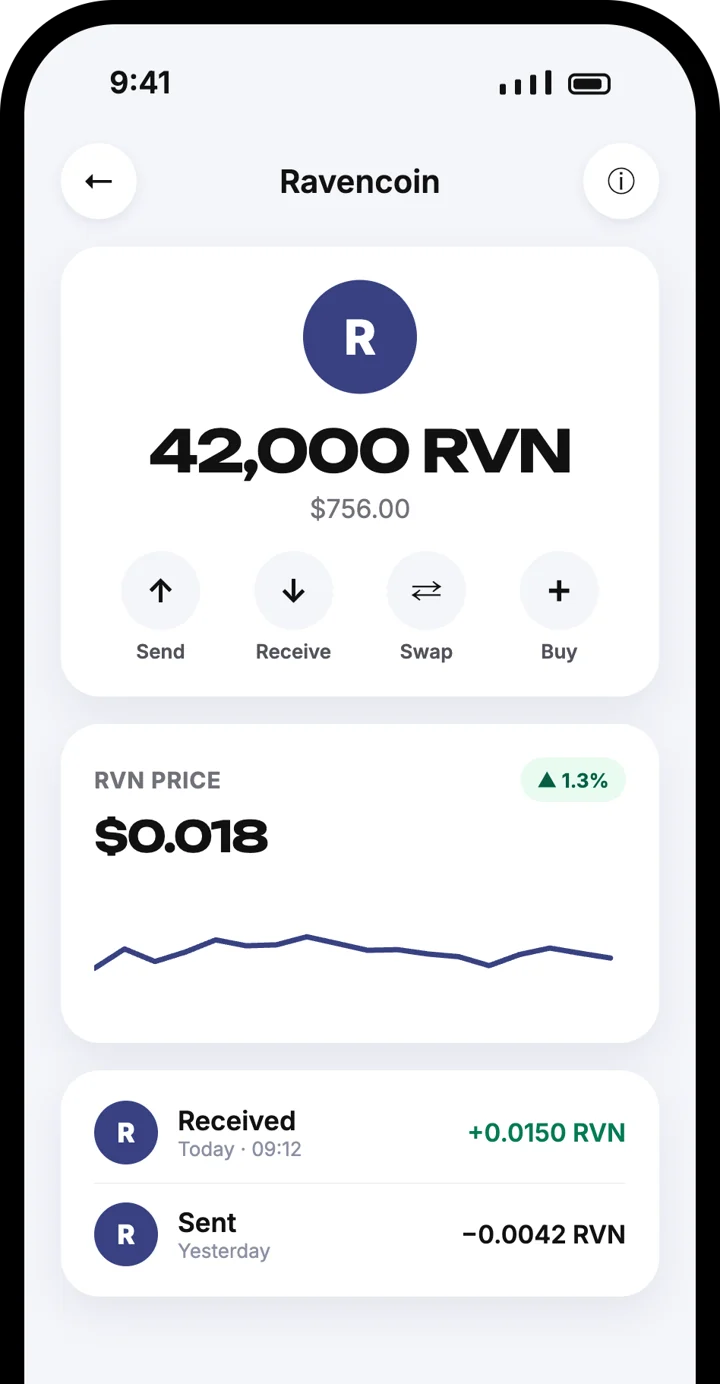



Ravencoin was designed with a narrow, deliberate purpose: making it straightforward to issue and transfer tokens representing real-world or digital assets on a dedicated chain, separate from a general-purpose smart contract platform. It launched with no premine and no ICO, distributing RVN entirely through mining from the start, which shaped a community that tends to value transparent, permissionless issuance.
Under the hood, Ravencoin uses a UTXO (unspent transaction output) model, the same fundamental accounting approach Bitcoin uses, rather than the account-balance model common on EVM chains. Each RVN transaction consumes existing outputs and creates new ones, which is worth understanding because it affects how wallets calculate available balances and construct transactions, especially when you are consolidating many small mining payouts.

Ravencoin uses a proof of work mining algorithm, and many holders first acquire RVN through mining pools rather than buying it outright. Pool payouts are typically sent directly to a wallet address you provide, often accumulating in smaller batches over time, which is one reason UTXO management and wallet fee handling become practically relevant rather than theoretical.
If you mine RVN, the wallet address you configure in your pool account needs to be one where you actually control the private key. Pointing payouts at an exchange deposit address controlled by someone else defeats the point of mining for self custody in the first place, and exchange deposit addresses can also change or be misconfigured, leading to lost payouts.

Leaving RVN on an exchange after mining or purchasing it is the path of least resistance, but it reintroduces exactly the kind of counterparty dependency that a permissionless, no-premine chain like Ravencoin was arguably built to avoid. Exchange holdings are subject to that platform’s solvency, security incidents and withdrawal policies, none of which you control.
Self custody puts the private key controlling your RVN on your own device instead. That means no one can freeze or seize the funds without your key, but it also means you are solely responsible for backing up your recovery phrase correctly. For anyone holding RVN for more than a short trading window, that tradeoff is usually worth making.
Whatever wallet you choose for RVN, the recovery phrase it generates is the single point of failure and the single point of protection. Write it down on paper, verify you copied it correctly, and store it in a location that is protected from fire, water and casual discovery, ideally in more than one physical place.
Never store a recovery phrase as a plain text file, screenshot or note synced to the cloud. Those are among the most common ways funds are stolen, since a compromised email or cloud account can expose the phrase without any interaction with the blockchain itself. Treat the phrase with the same seriousness as a physical asset you cannot replace.
Atom Wallets is a non-custodial, multi-chain wallet supporting 9+ major chains, including Bitcoin, Ethereum, TRON, BNB Chain, Solana, Polygon, Avalanche and XRP. RVN is not currently on that native support list, so this page is intended as an honest guide to Ravencoin storage principles and a recommendation for the assets Atom Wallets does support directly, rather than a claim of built-in RVN support.
For holders who mine or hold RVN but also transact in Bitcoin and stablecoins, that distinction matters practically. You would keep RVN in a dedicated wallet suited to it, while using Atom Wallets for the Bitcoin, USDT and EVM-chain side of your holdings, all under proper self custody rather than mixing everything into exchange accounts.

Many Ravencoin miners and holders also keep Bitcoin as a longer-term store of value and USDT for quickly moving between positions without exposure to price swings. Atom Wallets handles both natively: Bitcoin under full self custody, and USDT on TRON (TRC-20) with a flat $2 fee per transfer where network fees can be paid directly in USDT, so you never need to separately acquire TRX just to move funds.
Keeping these balances in one well-secured, non-custodial app, with biometric lock and hardware wallet support, reduces the number of separate seed phrases and apps you have to track, which in practice is one of the more overlooked ways people lose funds through simple mismanagement rather than any external attack.

Double-check the receiving address character by character before sending any RVN, since UTXO-based chains have no built-in reversal mechanism once a transaction confirms. Small test transfers are worth the extra minute when moving a meaningful amount for the first time to a new wallet or exchange.
Keep your mining or wallet software updated from official sources only, verify checksums when available, and be skeptical of unsolicited support contact asking for your recovery phrase or private key. These basic habits prevent the overwhelming majority of losses in the Ravencoin community and across crypto generally.